The Pilot Steam Cracker
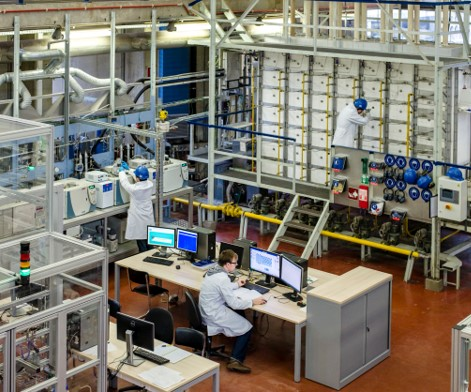
LCT disposes of a pilot plant unit for the thermal cracking of hydrocarbons, next to a number of bench-scale units. These experimental set-ups are used to determine the kinetics of the cracking reactions and of coke deposition in both the radiant coil and the transfer line exchanger (TLE). Fouling inhibition in reactor and TLE is also studied. Major advantage of the pilot unit is its extremely flexibility. A wide variety of hydrocarbons, ranging from gaseous feeds to waxes, can be handled. Moreover, the reactor design allows to obtain a broad range of process conditions. The pilot plant also offers the opportunity to industrial groups to test industrially important and/or new feeds, additives, coatings etc. in pilot plant experiments done by LCT personnel.
High-Throughput Intrinsic Kinetics (HTK) Reactor Systems
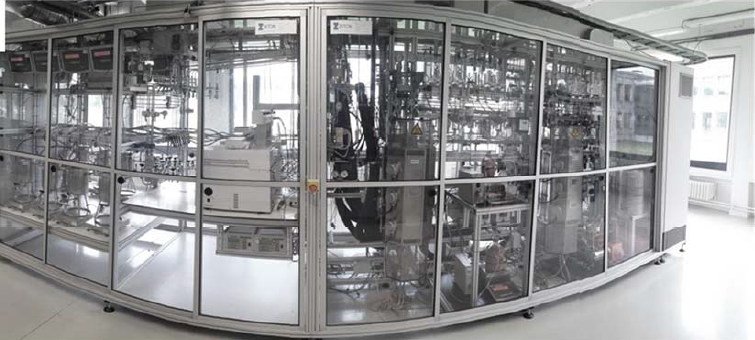
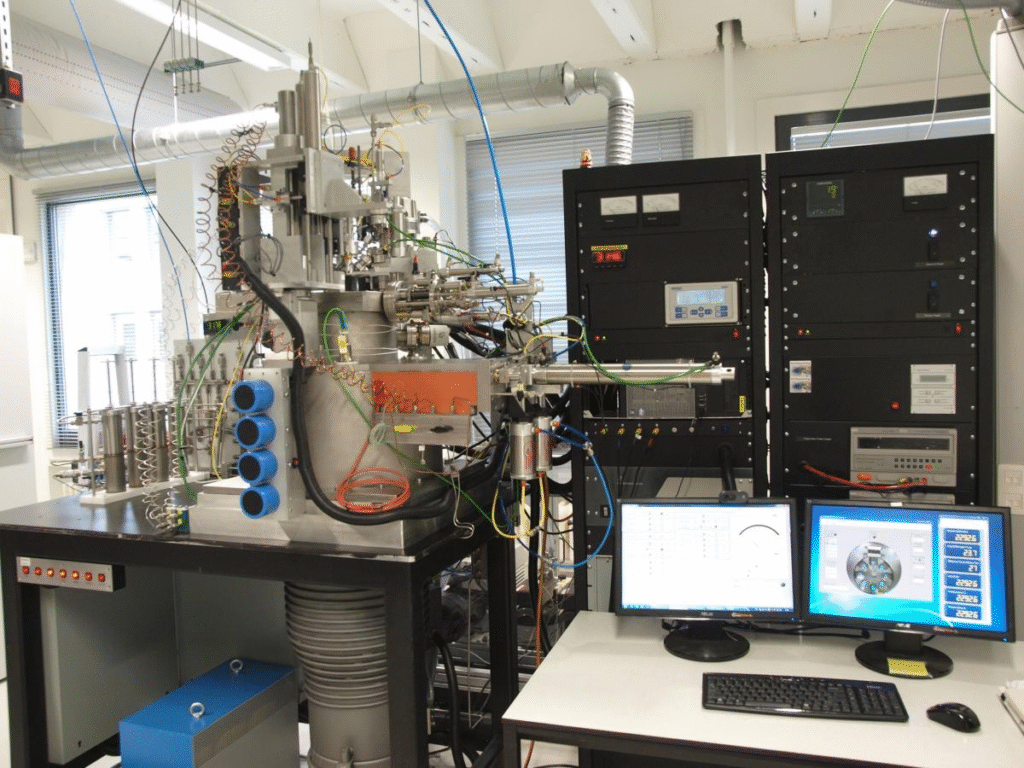
Two complementary high-throughput kinetics (HTK) set-ups are available, i.e. a high-throughput kinetics screening set-up (HTK-S) and high-throughput kinetics mechanistic investigation set-up (HTK-MI). They are specifically designed to achieve the goals put forward in the information-driven catalyst design methodology, i.e. catalyst screening and mechanistic investigation while providing reliable intrinsic kinetic data for microkinetic model construction. The main goal of the HTK-S set-up is the fast parallel screening of a large variety and, hence, number of catalysts. Both simple and complex reaction networks can be dealt with. This set-up corresponds to the screening step. After the screening stage, a benchmark catalyst is selected, on which an extensive experimental study is performed on HTK-MI complemented by a few additional catalysts for the catalyst descriptor determination. This is depicted as the mechanistic investigation step.

TAP Reactor System for Materials Kinetic Characterization
The Temporal Analysis of Products (TAP) Reactor System is used to characterize the reaction kinetics of chemical conversion over materials or heterogeneous catalysts. Characterizing the relationship between surface composition and kinetic properties enables the rational design of materials based on microkinetic detail from simple reaction steps. The advantage of Temporal Analysis of Products (TAP) comes from the small pulse size (approximately 1014-1016), which is several orders of magnitude smaller than the number of active sites in a typical sample. As a result, from pulse to pulse, the kinetic state of the material can be probed without inducing a significant change. Over a long series of pulses a material can be incrementally manipulated, for example from oxidized to reduced. Observing the evolution of kinetic properties from TAP data can shows how the processes such as bulk oxide transport, surface diffusion, number of active site, site blockage, reaction products and effect of the surface intermediates and products impact the reaction mechanism. This information can be used to better understand deactivation mechanisms or to distinguish why materials of similar composition and preparation perform differently at process conditions.
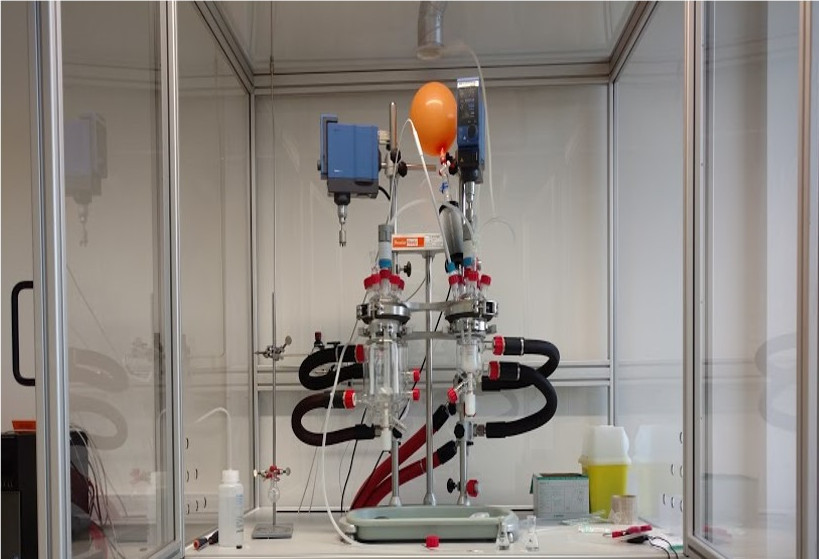
Emulsion polymerization set-up
Emulsion polymerization can be experimentally conducted at various reactor sizes (up to L scale) to study nanoparticle synthesis, accounting for all length and time scale. Chain length and particle size distributions can be measured upon further analysis.
Vortex reactor technology
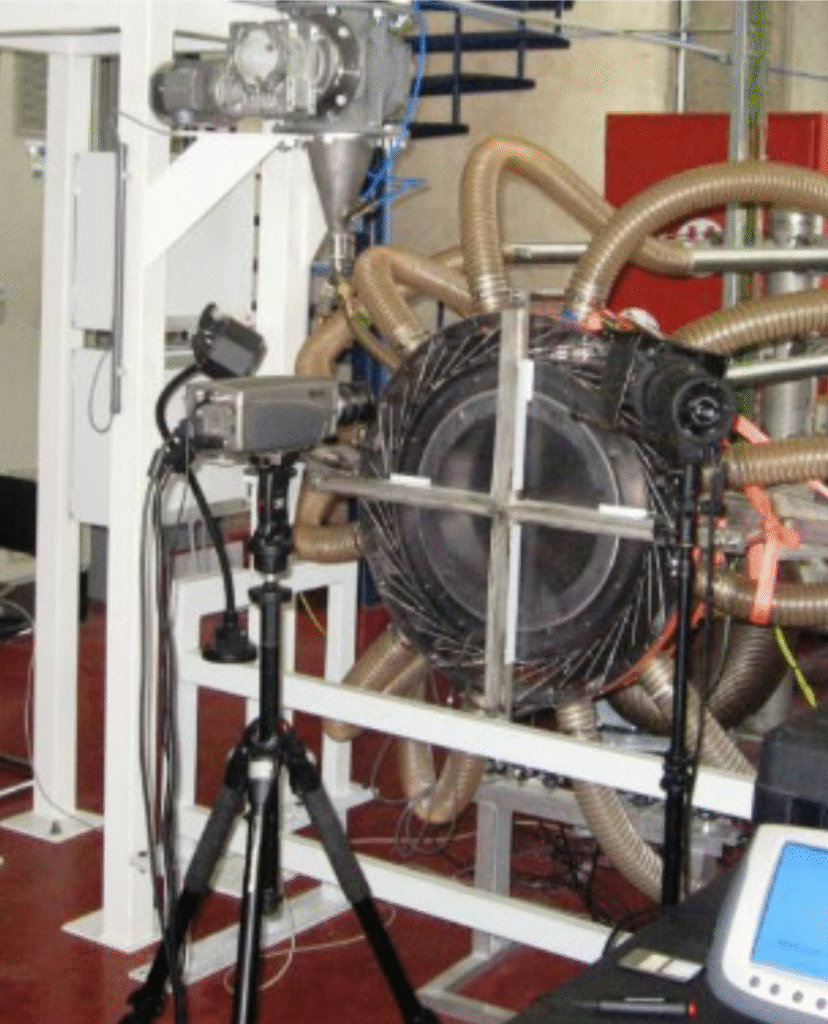
The gas-solid vortex reactor in a static geometry (GSVR−SG) or shirt vortex reactor is a disruptive reactor concept that makes use of a rotating bed. The unique attributes of the vortex reactor allow it to significantly improve certain processes that suffer from convective heat or mass transfer limitations between phases. Other advantages may arise from the ability to work with different fluidization agents such as steam or hydrogen. The high centrifugal acceleration (greater than 30 g’s) generates much higher slip velocities and more intense heat and mass transfer between phases.
Since the GSVR−SG technology is relatively new, the state of the art is still at the level of cold flow assessment analyses, experimentation and modeling, with valuable experimental studies carried out for different applications.
The LCT has been working on further developing the reactive vortex reactor technology and has absolute freedom to operate.