
Equipment
Microreactor systems
Description
Different microreactors are available at our research group. We use both complete systems and self-made systems by combining one or more pumps with a tubular reactor and/or a microchip. Within our lab, flow reactions with O2, CO2, H2, and CHF3 are possible. In-line work can be done by a Zaiput liquid/liquid separator and in-line analysis by an in-line FTIR (Bruker).
Complete systems
Labtrix® Start (Chemtrix)
Internal volume: 1, 5 or 10 µl depending on the reactor chip used
Temperature range: -15°C to 195°C
Pressures up to 25 bar
Wetted materials: glass, PEEK, PTFE, Techtron
KiloFlow® (Chemtrix)
Internal volume: 13 ml
Temperature range: 10°C to 150°C
Pressures up to 20 bar
Wetted materials: glass, PEEK, ETFE, perfluoroelastomer
X-CubeTM (ThalesNano)
Temperature range: 20°C to 200°C
Pressures up to 150 bar
Wetted material: stainless steel
Compatible with gases (H2, O2, …)
Compatible with catalyst cartridges (Pd/C, Raney Ni, …)
H Cube Mini (ThalesNano)
Temperature range: 20°C to 100°C
Pressure 1 bar to 100 bar
Flow rate 0.3-3 ml/min
Maximum hydrogen production rate 25-30 Nml/min
Water reservoir capacity 100 ml
Vapourtec Easy-MedChem V3
An adjustable packed bed column reactor – ambient to 150°C
A tube reactor assembly – ambient to 150°C
User interface with manual control software
3 V-3 pumps
Africa (Syrris)
Fully automated, flexible and easy-to-use microreactor system
Wide temperature range
Reagent pump module with flow rate range of 2.5-2500 µl/min
Pumps
ReaXus-Model 6010R (Teledyne ISCO)
High performance reciprocating peristaltic pump
Accurate flow rate control up to 10 ml/min
Pressure capability up to 6000 psi (414 bar)
WADose (Flusys)
Compact high-pressure dosing peristaltic pump (dual piston)
Dosing range 0.001-40 ml/min
Viscosity range up to 40 mPa.s
Pressure range atm-400 barg
Pump head material PEEK
FlowSyn Binary Pump Module (Uniqsis)
Peristaltic pump
Flow rates from 5 µl/min up to 10 ml/min
Glass static mixer + Teflon 5 ml coil reactor
10 bar BPR
Intelligent Pump AI-12 (Flom)
Peristaltic pump
Double-plunger reciprocating method
Maximum discharge pressure 5MPa
Range of flow rate setting 0.1-50 ml/min
Pressure limiter upper limit 0-10 MPa
Syringe pumps e.g. Fusion 101 (Chemyx)
Reactors
- Glass chips: e.g. Glass static reactor 1.6 mL (Uniqsis)
- PTFE tubing with multiple radii
- PFA tubing with multiple radii
- PEEK tubing with multiple radii
Bruker Avance-III 400 MHz NMR Spectrometer equipped with BRUKER 5 mm BBFO 400 MHz Z-gradient high resolution probe

Description
State-of-the-art NMR spectrometer equipped with an observe broadband high resolution probe, fitted with an actively shielded single axis Z-gradient for 5 mm sample diameters and 400 MHz standard-bore or wide-bore magnets. The inner NMR coil can be tuned to observe 19F or any nucleus in the range from 31P to 15N. The outer NMR coil is tuned for either 1H decoupling or observation. The probe is fitted with a 2H lock channel and automatic tuning and matching (ATM).
Signal/Noise
19F sensitivity ≥250:1 (TFT sample, with 1H decoupling)
31P sensitivity ≥140:1 (TPP sample)
13C sensitivity ≥160:1 (ASTM sample)
15N sensitivity ≥20:1 (90% formamide sample)
1H sensitivity ≥250:1 (0.1% EB sample, 2ppm noise)
Pulse Widths
19F pulse width ≤15μs (TFT sample)
31P pulse width ≤15μs (TPP sample)
13C pulse width ≤10μs (ASTM sample)
15N pulse width ≤18μs (90% formamide sample)
1H pulse width ≤15μs (0.1% EB sample)
Lineshape
13C spinning lineshape ≤0.2/2/4 Hz (50%/0.55%/0.11%, ASTM)
1H spinning lineshape ≤0.6/6/12 Hz (50%/0.55%/0.11%, 1% CHCl3)
Z-gradient
The probe is fitted with an actively shielded single axis Z-gradient.
Maximum gradient strength is 50 gauss/cm
Variable Temperature Range
Variable temperature range is from -150°C to +150°C*
Liquid chromatography – Mass spectrometry

Agilent 1100 LC/MSD SL – Agilent 1200 LC – 1100 Series MSD VL
HPLC : UV detection by DAD
MS : ESI – single quadrupole – electron multiplier
Agilent 1100 Prep LC
HPLC : VWD detection – fraction collector
Agilent 1260 Series
HPLC : UV detection by DAD
MS: ESI – singe quadrupole – electron multiplier
ELSD: Infinity II – Evaporative Light Scattering Detector
Flash chromatography
Chemical separation technique used to purify chemical mixtures.
BUCHI Reveleris X2: Normal phase flash chromatography
Grace Reveleris: Reversed phase flash chromatography
Shimadzu IRAffinity-1S FTIR Spectrometer
Description
Apparatus to determine IR absorbance/transmittance and to acquire IR spectra.
Thermo Scientific Genesys 180 UV-Vis Spectrometer
Description
Apparatus to determine UV-Vis absorbance/transmittance and to acquire UV-Vis spectra.
CEM Discover Microwave Synthesizer
Description
Apparatus for heating sealed pressure vessels with the power of microwave energy.
Ball Mill Retsch MM400
Description
Apparatus used for chemical synthesis. Alternative for synthesis via batch chemistry. Maximum frequency of 30 Hz.
GC-MS Agilent 8890

Description
The Agilent 8890 Plus GC system is coupled to a quadropole mass selective spectrometer 5977B MSD
Gerstel MPS2 autosampler has various introduction techniques: liquid, dynamic headspace, SPME and thermal absorption
GC-MS Agilent 6890 Plus
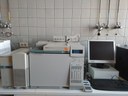
Description
The Agilent 6890 Plus GC system is coupled to a quadropole mass selective spectrometer 5793 MSD
Gerstel CIS-4 PTV injector
GC-FID
Description
The Agilent 6890N GC system is coupled to a flame-ionization detector
Injector: Agilent 7683 Series
BUCHI Melting Point M-560
Description
Apparatus to determine melting point of solid pure compounds and boiling point of pure liquids.
Harvest Right Pharmaceutical Freeze Dryer
Description
Freeze drying apparatus to remove water from chemical samples.
Parr High Pressure Reactor 4793
Description
Stainless steel high pressure reactor of 100 mL with maximum pressure of 200 bar. Used for chemical reactions with carbon dioxide gas.
Organic Elemental Analysis 2400 Series II CHNS/O Elemental Analyser
Description
One analyser with three modes of operation : CHN, CHNS and Oxygen
Advanced cumbustion design for handling virtually any type of samples
Frontal chromatography for simple , reliable and accurate measurements
Automated weight entry
Analytical detector range (element range (mgs)):
Services
The SynBioC Research Group is equipped to perform several types of analyses on organic compounds:
- NMR analyses
- IR analyses
- UV analyses
- GC analyses
- LC analyses
- MS analyses
For more information regarding prices and technical aspects , please contact Prof C. Stevens , Prof M. D’hooghe or Prof S. Mangelinckx, Prof T. Heugebaert.
